learning to take up space
Unlearning the Habit of Shrinking Ourselves
Life has a way of shrinking us down. Many of us learn early in life to stay in line, lower our voices, and avoid drawing attention to ourselves. While some of that training served a purpose when we were young, we eventually carry it into adulthood, along with the idea that taking up space is a bad thing.
Some of us probably got that message more than others. Women, in particular, are conditioned to be agreeable, deferential, pleasant, and polite. We learn to accommodate so we don’t seem bossy or demanding, or commit one of the greatest social sins of all, being too opinionated.
This type of shrinking isn’t limited to gender. Family dynamics, school and workplaces, religion, culture, and social norms influence how much, or how little, we show up in various situations, shaping how we relate to authority.
Before we know it, we begin expressing this tendency in all kinds of ways. We soften our opinions or apologize unnecessarily. We qualify our statements and wait for permission. Think of how often you’ve yielded in conversation or assumed someone else’s confidence meant they knew better than you.
It can happen without our even noticing. We use words and phrases in our everyday language like just, maybe, I could be wrong, I don’t know if this makes sense, sorry to bother you… And before we’ve even gotten to the core of what we’re saying, we’ve already established that we’re not quite sure we deserve to speak at all.
It’s subtle, but it’s there: we become unwitting participants in our own minimizing.
Authority: is it real or is it perceived?
There are good reasons to heed instructions from someone whose role it is to ensure our safety or our success. We rely on their expertise and the wisdom of their experience for guidance and support. Our parents, teachers, police, and our bosses are given authority over us for those very reasons.
But some people in our lives haven’t necessarily been granted authority by someone else. These are the ones whose authority is assumed, and we’ve assigned it to them because they seem important, older, louder, or more credentialed than we are. We tend to acquiesce because the lines between power and credibility become blurred, based more on our perceptions of social standing than anything else.
As we consider the people in our lives to whom we likely defer in one way or another, it can help to distinguish between real and perceived authority and reflect on how we respond to both.
How shrinking becomes automatic
With enough practice and repetition, we develop an almost reflexive response to someone we view as above us or somehow holding some level of control over us. Eventually, other people don’t have to ask us to make ourselves smaller because we start doing it automatically.
We might anticipate their reactions before they happen, editing ourselves before anyone can object to our words or our views. We step aside and let others pass more easily. We decide our questions probably aren’t important enough to ask. It can become so ingrained within us that we may even interpret our responses as part of our personalities: I’m just quiet. I’m just not an assertive person. But how much of what we believe about our personal traits is genuinely part of our inherent personality, and how much is a set of learned responses that have become so habitual we believe they’re part of who we are?
This is how insidious this kind of shrinking can be. The good news is that once we become aware of our tendencies and responses, we can realize we have more choice than we might have thought.
What “taking up space” actually means
I rather like this phrase. I like the imagery, the sense of movement and expansion. Yet people can easily misinterpret it as something far bigger and more aggressive than it actually implies. It might help to clarify what it isn’t: It’s not about becoming the loudest person in the room or dominating conversations. It’s not insisting we’re right, bulldozing people in conversation, or suddenly acquiring a gigantic, obnoxious personality. What’s interesting about taking up space in this sense is that there’s plenty of it to go around. Think of “space” here as an infinite resource, one that never runs out. Seen from that lens, you don’t have to take someone else’s space in order to fully occupy your own.
Here are some examples of what “taking up space” might look like:
· Finishing your sentence when interrupted.
· Saying “Hang on, I wasn’t finished.”
· Initiating a conversation.
· Asking your next question.
· Offering your opinion without first explaining why it might be stupid.
· Telling someone what you need.
· Allowing for a difference of opinion without immediately retreating.
· Holding your head up when entering a room rather than hunching over because you hope no one notices you.
· Wearing clothes and accessories that make you happy.
· Saying “no” when that’s what you mean.
· Saying “I’m not comfortable with that” when that feels like the right answer.
If any of these feel new or intimidating to you, I understand. I felt that way too when I decided to claim space for myself. When we first start taking up space in everyday situations, it can feel as though we’ve committed a massive breach of social conduct. We might even feel that we come off as brusque or offensive compared to our usual manner of responding, when in fact we’re just asserting our right to exist alongside everyone else.
When in doubt, remember that respect doesn’t require deference. Kindness doesn’t require self-erasure. Confidence doesn’t require dominance. And there is room for you in the conversation. Maybe taking up space begins with giving ourselves permission to show up just as we are, without feeling the need to dim our light for anyone else.
The trick? Practice.
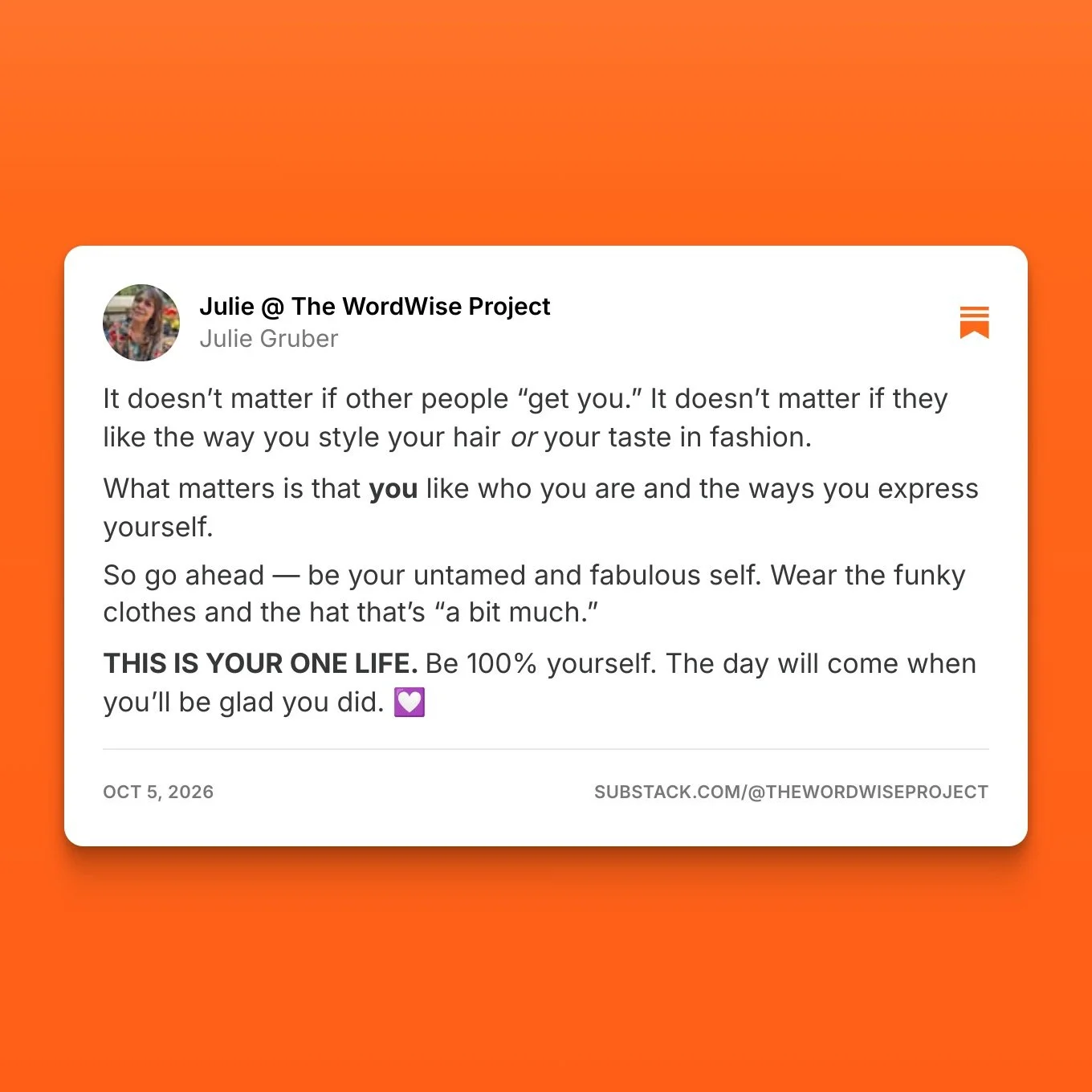
Here’s a recent Substack note I posted that reflects this:
Taking up physical space
The conditioning we absorbed can show up in how we hold our bodies, too. Our posture, our comfort with maintaining eye contact, how we choose our seat in a room or whether we hide ourselves at the edge of it, whether we automatically move out of someone’s way, or how we enter a room — each of these is a clue for us to decipher. Our bodies can reveal habits and responses that our conscious minds haven’t picked up on yet.
We might choose to experiment with any of the following ways to take up more physical space and see how that feels:
· Walking into a room a little taller or more confidently.
· Sitting where you actually want to sit.
· Looking at someone while you speak.
· Carrying your body with reverence.
· Letting your shoulders drop.
· Allowing yourself to look like you belong there.
· Sitting or standing where you can be seen and heard.
· Walking down the street or hallway like you mean it.
When you try these, ask yourself what feels comfortable and what feels harder. There’s no wrong answer and no need to correct yourself either way. You’re just noticing how you respond physically in situations where you feel the impulse to “get smaller” and gently challenging that, a little at a time. With practice, you may just feel like you have as much right to be there as anyone else in the room (which you do).
Language as one place to start
Next time you’re at a gathering or other interpersonal situation, make a mental note to pay attention to your words. Notice even the small things (it’s often what feels like the smallest things), like unnecessary apologies. Sorry, can I ask a question? Sorry, could I get past you? Sorry, I have a different idea. In those examples, that “sorry” essentially tells others you’re apologizing for being in their presence.
I’m not saying you should never apologize when the situation truly warrants it. What I’m suggesting is something else — it’s more about how we offer disclaimers that discredit what we’re about to say before we’ve even said it. The point is to notice when an apology is genuine and when it stems from that pesky reflexive self-shrinking.
If you catch yourself apologizing unnecessarily, don’t be too hard on yourself. We’re not going to add to the issue by berating ourselves further into a submissive posture. It’s much more helpful to simply get curious. Why did I apologize? What made me feel like I had to? How might I respond differently next time? Catching yourself is actually a very positive sign – it lets you know you’re paying attention, noticing your responses, and pausing to reflect on them. Eventually, we can learn to catch ourselves before we utter that apology and choose something else instead.
And while language gives us one place to recognize these habits, our responses to authority can reveal just how deeply ingrained they are.
Authority and trusting ourselves
I’ll be the first to say that expertise matters. Experience and credentials matter. Yet we mustn’t mistake those for infallibility or perfection, and another person’s expertise doesn’t negate our knowledge of our own experience.
Let’s take medicine as an example. We learn to trust doctors and the medical system to manage our care effectively. But somewhere along the way, we’ve come to almost deify our providers and hold their opinions as sacred. We follow their advice and accept their recommendations, and that’s all well and good. At the same time, it’s all too common to be expected to set aside what we know about our own bodies and go along passively because “they must know better.”
There’s a very fine line between following medical advice and surrendering what we know to be true. I won’t claim to know more than they do about anatomy or the disease process. But like many other people, I’ve been told things about my body when, in fact, they weren’t true. And while I could go on and on about this topic, I’ll keep it here as an example of how easily we can defer to authority and unconsciously diminish our own.
There are many other instances where we hand over the power to someone else out of habit or perception of authority. Imagine running into your favorite celebrity or any other confident personality. How do you imagine you’d react? How about someone with a certain title or status that you admire? Your new boss or your spouse’s older relative? Chances are, any of these situations can trigger that reflex to defer. We might even be swayed to follow their lead without question or protest. It’s worth saying again that in each of these situations, we still have a choice, and whether we act on it is completely up to us. There’s a big difference between respecting someone’s knowledge and status and surrendering our own judgment.
There’s something to bear in mind once we become more aware of our responses to real or perceived authority: learning to comfortably take up more space probably won’t happen overnight. Decades of conditioning won’t likely be undone just because we’ve understood it rationally, and we shouldn’t expect it to. There will be times when we still shrink, defer, apologize, go quiet, or think of that one perfect thing we wish we’d said three hours after the conversation ended. That’s all part of the ongoing work of unlearning, rather than evidence that we haven’t successfully “fixed” ourselves.
So, it’s okay if you don’t suddenly become A Person Who Takes Up Space. I don’t know anyone who’d refer to themselves that way, and I certainly don’t. What matters are those micro-moments of awareness, that gentle nudge to expand just a little more, and the tiny increments of making the choices available to us. In the end, taking up space may have less to do with becoming bigger and more to do with noticing all the ways we've learned to make ourselves smaller. That’s already a very good start.
Questions to explore:
· When did I decide this person automatically knows better?
· What do I actually know here?
· Am I agreeing because I'm persuaded, or because I'm intimidated by someone else’s certainty?
· Where in my life do I find myself making room for others at the expense of my own needs or opinions?
· What do I tend to apologize for, even when I've done nothing wrong?
· Are there parts of my personality that are actually habits I learned to fit in or feel safe?
· What is one small way I could take up a little more space without feeling the need to explain or justify myself?
And here’s a little book news: My new book is now available in paperback and eBook!
A Regular Person’s Guide to Living with Chronic Pain is about much more than pain. It's about finding our way through the losses, challenges, and unexpected turns that come with living in a body that doesn't always cooperate, while continuing to build a life filled with meaning, connection, and purpose.
Written from lived experience, it's a thoughtful, practical, and hopeful companion for anyone navigating life alongside chronic pain.
Available on Amazon, with a hardcover edition on the way soon.

Finally, I live by a busy highway and I also have three wonderful kitties who LOVE to help me with just about everything. While I make every effort to edit out the inevitable background sounds, some occasional ambient noise will still make its way through. Thanks for bearing with me.
And remember, I’m with you on the journey.
Julie 💜